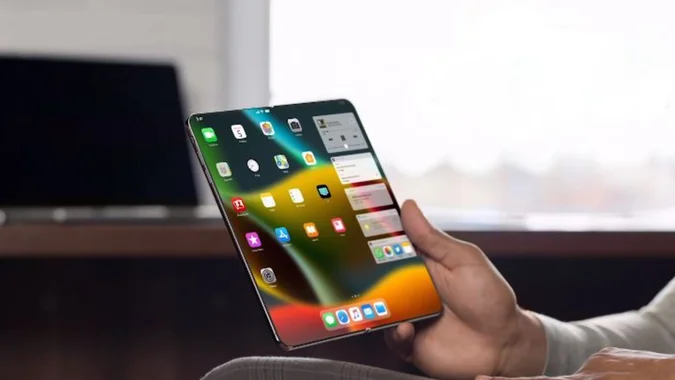
After years of watching from the sidelines, Apple appears ready to enter the foldable phone arena with what could be the most polished first attempt we’ve ever seen. Leaked CAD renders, sourced from iPhone-Ticker.de and revealing a device codenamed V68, show a folding iPhone that doesn’t just mimic the competition. It rethinks the entire category, packing what feels like a full iPad mini experience into something that genuinely slips into your pocket. Set for a potential September 2026 debut, this isn’t just another foldable. It’s Apple’s statement on what the form factor should be.
| Metric | Value | Unit | Notes |
|---|---|---|---|
| Outer Display Size | 5.5 | inch | 83.8mm wide, 120.6mm tall when folded |
| Inner Display Size | 7.76 | inch | Unfolded: 167.6 x 120.6mm |
| Inner Display Resolution | 2,713 x 1,920 | pixels | Near iPad mini density for sharp text |
| Thickness (Folded) | 9.6 | mm | Includes hinge mechanism |
| Thickness (Unfolded) | 4.8 | mm | Excluding camera bump; ultra-slim profile |
| Frame Material | Titanium & Aluminum | — | Mixed construction for durability and weight |
| Rear Camera System | Dual | lens | Similar setup to iPhone 17, quality focus |
| Front Camera | Under-Display | — | No visible notch on inner screen |
| Target Launch | September 2026 | — | Based on current leak timeline |
Apple’s Foldable Design Philosophy: Wider, Not Taller
The first thing that strikes you about these CAD renders is the proportions. When closed, the device measures 83.8mm wide by 120.6mm tall. That’s a wider than tall stance, a deliberate departure from the tall, narrow outer screens that dominate current foldables. This isn’t an accident. Apple’s engineers have seemingly prioritized a shape that fits better in side pockets and feels more natural to grip one handed. It transforms the closed device from a cramped secondary screen into a genuinely usable mini tablet folded in half.
Unfold it, and you’re greeted with a 7.76 inch canvas at 2,713 by 1,920 pixels. The dimensions, 167.6 by 120.6mm, bring it incredibly close to the screen real estate of an iPad mini. Imagine splitting your screen between a note taking app and a reference document during a meeting, or watching a video with controls tucked neatly to the side without everything feeling squished. That’s the daily utility Apple is chasing here. This pocket sized iPad mini experience is the core promise.
The Engineering Marvel: A Truly Crease Free Display
Here’s where Apple’s notorious patience pays off. While competitors have raced to be the thinnest, these leaks suggest Apple prioritized eliminating the crease. The device measures 9.6mm thick when folded and 4.8mm when open. For context, Samsung’s Galaxy Z Fold 7 comes in at 8.9mm closed and 4.2mm open. That extra millimeter or so? It’s likely housing the engineering required for what’s described as a “crease free display through laser drilled microstructures.”
This isn’t just incremental improvement. It’s a potential category defining feature. The visual distraction of a permanent seam down the middle of your content has been the foldable’s Achilles’ heel. If Apple has cracked a reliable, durable method to make it disappear, it changes the entire value proposition. Opening this phone should feel like revealing a seamless slab of glass, not unfolding a piece of advanced origami. Achieving this crease free iPad mini display could be their biggest selling point.
Build, Cameras, and the Daily Grind
Durability is the other half of the foldable equation. The leaked details point to a mixed titanium and aluminum frame. Titanium brings exceptional strength to weight ratio, ideal for the stress points around the hinge, while aluminum keeps the overall mass in check. The haptics, always an Apple strong suit, will need to be perfectly tuned to make the physical act of folding and unfolding feel satisfying and precise.
On the camera front, Apple appears to be taking a “quality over quantity” approach. A dual rear system, likely borrowing sensors and computational photography chops from the iPhone 17 lineage, suggests they’re confident they can deliver flagship grade photos without a bulky array of lenses. The inner screen’s under display selfie camera is another win for immersion. No notch means videos and games expand edge to edge without interruption.
Think about your daily flow. Sliding this wider folded phone into your jeans pocket actually works. Pulling it out to quickly check a notification on the 5.5 inch outer screen is a one handed affair. Then, when you need more space, maybe to sketch a diagram while on a call or read a long article comfortably, it unfolds into a near perfect iPad mini analog. The software will be crucial, of course, but the hardware foundation for that seamless transition between phone and tablet is clearly here.
The Competitive Landscape and Supply Reality
Compared to the Samsung Galaxy Z Fold line, Apple’s approach seems more conservative in specs but more ambitious in experience. Samsung fights for millimeter thinness and spec sheet wins. Apple, if these leaks hold, is fighting to make the foldable disappear, both in your pocket and in your hand when you’re using it. The crease free display is the battleground.
However, turning these CAD files into millions of devices on store shelves is a monumental challenge. The complex hinge mechanisms, the yield rates on those laser drilled micro structured displays, and the assembly of a mixed material frame all point to potential major production hurdles. Industry whispers already suggest supply could be extremely tight at launch, potentially keeping this device elusive well into 2027. When you finally see one, it’ll represent a small miracle of modern manufacturing.
Who Is This For, Really?
This isn’t a phone for everyone, at least not initially. The price will be premium, and the first generation nature means early adopters will be the target. But it speaks to a specific user: the professional who lives in their email and documents but hates carrying a separate tablet. The creative who wants a digital sketchbook that’s always with them. The commuter who craves a large screen for media without the bulk in their bag.
Apple’s first foldable, as revealed in these leaks, isn’t trying to do everything. It’s trying to do a few things perfectly. It wants to be the device that makes you forget you’re using a foldable, where the technology fades away and you’re just left with the right screen for the moment, whether that’s in your palm or unfolded on the table. If they can deliver on that promise, and navigate the production maze ahead, they might not just enter the foldable market. They might just redefine it.