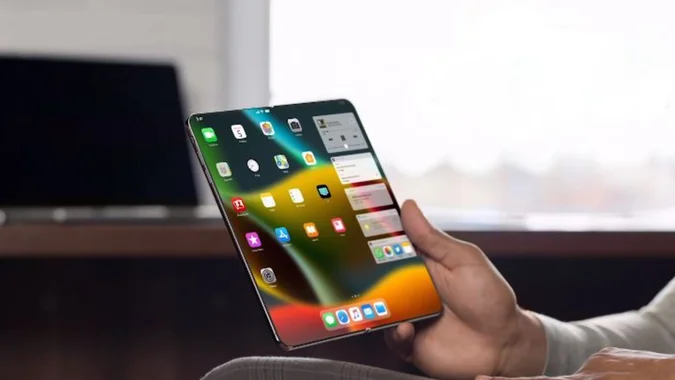
We’ve been hearing whispers about Apple’s foldable ambitions for years, but new CAD leaks finally give us something tangible to geek out over. According to detailed renders from iPhone-Ticker.de, Apple’s first folding iPhone, codenamed V68, isn’t just another me-too foldable. It’s shaping up to be a pocket-sized iPad mini that could redefine how we think about mobile productivity.
| Metric | Value | Unit | Notes |
|---|---|---|---|
| Outer Display Size | 5.5 | inch | 83.8mm x 120.6mm, wider-than-tall orientation |
| Inner Display Size | 7.76 | inch | 167.6 x 120.6mm, 2,713 x 1,920 resolution |
| Folded Thickness | 9.6 | mm | Including camera bump |
| Unfolded Thickness | 4.8 | mm | Excluding camera bump, thinner than iPhone Air |
| Estimated Battery | 4,500 | mAh | Dual-cell design for foldable form factor |
| Processor (SoC) | Apple A-series | — | Expected to be 2-3 generations ahead of current |
| RAM / Storage | 12 / 512 | GB | Base configuration expected |
| Rear Cameras | Dual | — | Similar setup to iPhone 17, quality over quantity |
| Front Camera | Under-display | — | No visible notch on inner screen |
| Frame Material | Titanium + Aluminum | — | Mixed construction for durability |
| Estimated Weight | 240 | g | Balanced for foldable form factor |
| Target Launch | September 2026 | — | Subject to production timelines |
The Pocket-Sized iPad Mini Experience
What immediately grabs your attention about these CAD renders is how Apple has rethought the foldable form factor. When closed, you’re looking at a 5.5-inch outer display measuring 83.8mm wide by 120.6mm tall. That wider-than-tall orientation isn’t just a design quirk. It means the device slips into side pockets more naturally than today’s towering smartphone slabs. You can actually forget it’s there until you need it.
Unfold it, and the magic happens. The inner screen expands to 7.76 inches with a sharp 2,713 x 1,920 resolution. That’s nearly identical to an iPad mini’s viewing area, perfect for split-screen apps, note-taking, or watching content without constantly zooming and panning. Imagine pulling this out on a flight and having a proper mini-tablet experience that came from your pocket.
Engineering the Impossible: A Truly Crease-Free Display
Here’s where Apple’s notorious perfectionism shows through. The leaked details reveal the company is prioritizing a true crease-free experience over chasing the absolute thinnest profile. At 9.6mm thick when folded and 4.8mm when open, it’s slightly thicker than Samsung’s Galaxy Z Fold 7 (8.9mm closed, 4.2mm open). But that extra millimeter matters.
Apple apparently cracked what Samsung couldn’t, using laser-drilled microstructures in the display layer to eliminate the visible crease that plagues current foldables. This isn’t just minimizing a crease. It’s engineering it out of existence. The company seems to have learned from the display technology advancements in the industry while putting its own spin on foldable screens.
Build Quality That Feels Like Apple
Hold any recent iPhone, and you immediately recognize that premium, solid feel. Apple appears to be bringing that same sensibility to its foldable. The mixed titanium and aluminum frame suggests a careful balance between durability and weight. Titanium provides structural integrity at the hinge points where stress concentrates, while aluminum keeps the overall weight manageable.
The wider folded stance creates what early reports describe as a “squarer profile.” It feels less like a traditional phone folded in half and more like a mini tablet that happens to fold. This design choice has practical benefits. It’s easier to grip horizontally, and it enables better one-handed use when closed. No more awkward thumb gymnastics to reach the top of a tall, narrow outer display.
Camera Philosophy: Quality Over Quantity
Apple’s camera approach here seems characteristically focused. The dual rear setup mirrors what we expect from the iPhone 17, prioritizing sensor quality and computational photography over adding more lenses for marketing bullet points. The inner screen features an under-display selfie camera with no visible notch or punch-hole, creating an uninterrupted canvas for media consumption and video calls.
Think about using this for FaceTime. The person you’re talking to sees you clearly through that under-display camera, while you get to enjoy your content or shared screen on a completely clean display. It’s those thoughtful details that separate Apple’s approach from simply checking feature boxes.
How It Stacks Up Against the Competition
Comparing this to Samsung’s current foldables reveals Apple’s different priorities. While Samsung has been chasing thinner profiles with each generation of its Galaxy Z Flip series, Apple seems willing to accept slightly more thickness to deliver a crease-free experience. It’s a classic Apple trade-off. Function over form, but executed in a way that still feels premium.
The September 2026 target launch gives Apple plenty of time to refine the engineering and software experience. However, as we’ve seen with previous reports about Apple’s foldable supply challenges, getting this to market in volume might be the real hurdle. Complex new display technology combined with Apple’s exacting quality standards could mean limited availability initially.
The Practical Impact on Your Daily Routine
Let’s talk about what this device actually means for your workflow. Picture starting your morning checking messages on that 5.5-inch outer display. Quick replies, scanning headlines, all doable without unfolding. Then you settle into your commute or coffee shop and unfold to that 7.76-inch screen. Suddenly you have proper split-screen for email and calendar, or enough real estate for comfortable document editing.
The pocket-sized iPad mini comparison isn’t just marketing speak. It’s about having tablet-level productivity in a form factor that doesn’t require a separate bag or conscious decision to carry it. This could be the device that finally makes foldables feel essential rather than experimental.
Why This Leak Matters More Than Most
Apple has watched the foldable market develop for years, studying what works and what frustrates users. These CAD renders suggest the company didn’t just decide to make a foldable iPhone. It decided to make an Apple foldable, with all the polish and user experience considerations that implies.
The crease-free display technology, the thoughtful aspect ratios, the materials selection, even the camera placement. Everything points to a product that’s been through Apple’s famously rigorous development process rather than rushed to market to check a category box.
Will it be worth the wait until 2026? Based on what these leaks reveal, Apple’s first foldable might just redefine expectations for what a folding device should be. Not just thinner, not just with more cameras, but genuinely better for how people actually use technology throughout their day. That’s the Apple approach we’ve seen before, and if they can apply it to foldables, the entire category could level up.