| Metric | Value | Unit | Notes |
|---|---|---|---|
| Outer Display Size | 5.5 | inch | 83.8mm wide × 120.6mm tall when folded |
| Inner Display Size | 7.76 | inch | 167.6 × 120.6mm unfolded, 2,713 × 1,920 resolution |
| Thickness (Folded) | 9.6 | mm | Mixed titanium and aluminum frame |
| Thickness (Unfolded) | 4.8 | mm | Excluding camera bump, crease-free display |
| Camera System | Dual Rear | — | Similar to iPhone 17, under-display selfie camera |
| Expected Launch | September 2026 | — | Codenamed V68, Apple’s first foldable |
Imagine slipping a device into your pocket that unfolds into something resembling an iPad Mini. That’s exactly what Apple appears to be engineering with its long-rumored foldable iPhone, and newly leaked CAD renders give us our clearest look yet at what could be the company’s most ambitious hardware leap in years.
The leaked documents, sourced from iPhone-Ticker.de, reveal a device codenamed V68 that’s shaping up to be Apple’s answer to the foldable market. But true to Apple’s philosophy, they’re not just copying what’s already out there. They’re rethinking the entire experience from the ground up.
The Display That Actually Disappears
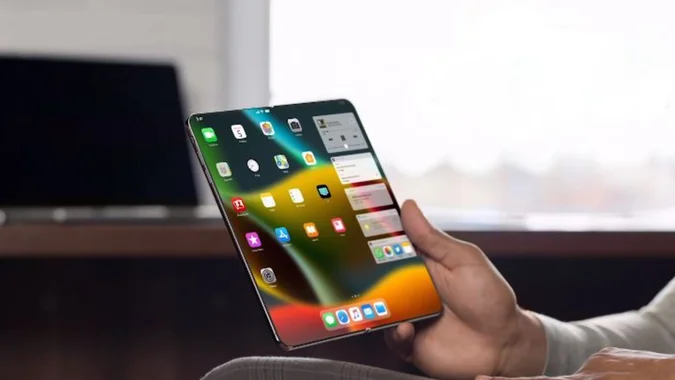
Let’s talk about that screen first, because it’s where Apple seems to be making its biggest statement. When unfolded, you’re looking at a 7.76-inch display with a sharp 2,713 by 1,920 resolution. That’s nearly identical to the viewing area of an iPad Mini, which means you’re getting proper split-screen multitasking and note-taking capabilities without carrying a separate tablet.
But here’s the magic trick, the engineering feat that’s eluded even Samsung. Apple appears to have cracked the crease problem through what the leaks describe as “laser-drilled microstructures.” Think of it as microscopic perforations in the display layers that allow the panel to bend without creating that visible line down the middle. When you run your finger across the screen, it should feel as seamless as any current iPhone display.
At just 4.8 millimeters thin when open, excluding the camera bump, it’s actually slimmer than the ultra-thin iPhone Air. That’s engineering confidence you can feel in your hands.
A Design That Thinks About Your Pockets
Now let’s talk about the folded form factor, because this is where Apple’s design philosophy really shines through. The 5.5-inch outer display measures 83.8 millimeters wide by 120.6 millimeters tall. Notice something about those dimensions? It’s wider than it is tall when folded.
This isn’t an accident. That wider stance means the device slips into side pockets more naturally than today’s towering smartphone slabs. It feels less like a traditional phone folded in half and more like a mini tablet that happens to fold. The 9.6 millimeter thickness when closed gives it a substantial, premium feel without being bulky.
The mixed titanium and aluminum frame should provide that signature Apple durability while keeping weight manageable. You can already imagine the satisfying click when it opens and closes, that precise mechanical feel Apple’s hinge engineers are undoubtedly perfecting.
Camera Philosophy Over Spec Sheet Numbers
Apple’s approach to cameras here tells you everything about their foldable strategy. They’re not chasing megapixel counts or cramming in extra sensors just to win spec sheet battles. The leaks point to a dual rear camera setup similar to what we expect from the iPhone 17, prioritizing computational photography and image quality over quantity.
On the inner display, there’s an under-display selfie camera with no visible notch or punch-hole. This creates an uninterrupted viewing experience for video calls and media consumption. Picture watching a movie on that expansive 7.76-inch screen without any distractions in your field of view.
It’s the kind of thoughtful integration that makes you realize Apple spent years watching competitors make mistakes before committing to their own design. They’re not just building a foldable phone, they’re building an Apple foldable experience.
How It Stacks Up Against the Competition
Let’s be honest, everyone’s going to compare this to Samsung’s Galaxy Z Fold series. The numbers tell an interesting story. At 9.6 millimeters thick when folded and 4.8 millimeters when open, Apple’s design is slightly thicker than Samsung’s Galaxy Z Fold 7 at 8.9 millimeters closed and 4.2 millimeters open.
But that extra thickness appears to serve a purpose, accommodating the engineering required for that truly crease-free display. It’s a classic Apple trade-off, prioritizing the user experience over being the absolute thinnest. The wider folded profile also addresses one of the biggest complaints about current foldables, those tall, narrow outer displays that can feel awkward for one-handed use.
When you hold it closed, it feels more natural in your hand, easier to grip horizontally. That might seem like a small detail, but it’s exactly the kind of ergonomic consideration that separates good hardware from great hardware.
The Reality Check on Availability
Now for the sobering part. While these CAD renders point to a September 2026 launch, industry sources suggest Apple’s foldable iPhone faces production reality checks that could make it incredibly difficult to find. The complex display technology and precision manufacturing required mean initial supplies will likely be extremely limited.
In fact, some analysts believe Apple’s first foldable might remain elusive through 2027 due to major supply chain challenges. The laser-drilled microstructure technology for the crease-free display represents uncharted manufacturing territory that could face significant yield issues.
This isn’t just another iPhone iteration, it’s an entirely new form factor with engineering hurdles that even Apple can’t simply will into existence overnight. The company’s notorious perfectionism means they won’t ship until the experience meets their exacting standards, which could mean longer wait times than initially anticipated.
What This Means for Your Next Phone Decision
If you’re considering a foldable phone today, this leak suggests Apple’s entry might be worth waiting for, especially if you’re already invested in the iOS ecosystem. The crease-free iPad Mini experience that actually fits in your pocket represents a compelling vision for what foldables could become.
But patience will be key. Apple’s approach here feels characteristically deliberate, learning from years of foldable market development while applying their unique hardware philosophy. They’re not just making a phone that folds, they’re reimagining how a device can transform from pocketable companion to productivity tool.
The wider folded design, the emphasis on display quality over thinness, the thoughtful camera placement, all of it points to a device engineered for how people actually use technology rather than chasing spec sheet victories. It’s Apple doing what Apple does best, watching the market mature, identifying what works and what doesn’t, then entering with a refined vision that feels inevitable in retrospect.
Whether you’ll be able to buy one in 2026 or have to wait longer remains to be seen, but these CAD leaks suggest that when Apple’s foldable finally arrives, it could redefine what we expect from phones that bend.